In 2003, the comprehensive project that had been awaited for several years to complete Planas del Rey finally began to take shape. Its purpose was to identify the work required to bring the development up to standard and prepare for its formal acceptance by Pratdip Town Council.
This new stage directly followed the renovation programme launched in 2001 and 2002.
A project estimated at more than €3.6 million
On 8 March 2003, the EUCC reported that the final project had still not been delivered. The mayor then announced that it should be available within the following weeks.
At the general meeting held on 10 August 2003, Pratdip’s new mayor, Josep Montané, confirmed that the Town Council now had the “Urban development project for the definitive integration of Planas into Pratdip”.
The estimated cost of the work was €3,606,070, approximately 600 million pesetas.
The project still had to be examined in order to determine:
- the Town Council’s financial contribution;
- the grants that could potentially be obtained;
- the different phases in which the work would be carried out.
In the autumn of 2003, the EUCC confirmed that its engineers were reviewing the document. An extraordinary general meeting would then be held to present the proposed work, its cost and the planned timetable to the property owners.
A procedure is proposed in 2004
At the general meeting held on 14 August 2004, the mayor presented the main stages envisaged for achieving the formal acceptance of Planas:
- review the preliminary project;
- request quotations from three companies;
- calculate each property owner’s share of the cost;
- convene an extraordinary general meeting;
- create a cooperation committee;
- establish the urban development contributions;
- carry out the work;
- finally proceed with the formal acceptance of the development.
However, the question of funding remained unresolved. Some property owners proposed that the Town Council should accept Planas in its existing condition, carry out the work and then recover the cost through a special levy spread over eight to ten years.
Another proposal was for the Town Council to take out the loan and then require the property owners to repay it in proportion to the size of their plots.
The mayor replied that the legality of these solutions still had to be verified.
Formal acceptance remains uncertain
During the same meeting, Francesc Sabaté, the EUCC’s lawyer, explained that the Town Council was not obliged to formally accept the development until the work had been completed. Early acceptance might possibly be considered, but a suitable legal arrangement still had to be found.
This answer confirmed the distinction already established in the agreement of 9 August 2002: registering the communal areas in the Town Council’s name did not mean that the development had been formally accepted by the municipal authorities.
By the end of the summer of 2004, an initial estimate and a proposed procedure existed, but the final scope of the work, its funding, the allocation of its cost and the timetable still had to be determined.
The project had therefore not yet resulted in an approved programme, but it had already placed the funding and formal acceptance of Planas at the heart of the discussions.
La Tribune de Planas
Reference documents
- Planas Info for the first quarter of 2003, in Spanish;
- Planas Info for the second quarter of 2003, in Spanish;
- Minutes of the extraordinary general meeting of 8 March 2003, in Spanish;
- Minutes of the general meeting of 10 August 2003, in Spanish;
- Planas Info for the fourth quarter of 2003, in Spanish;
- Planas Info from December 2003, in Spanish;
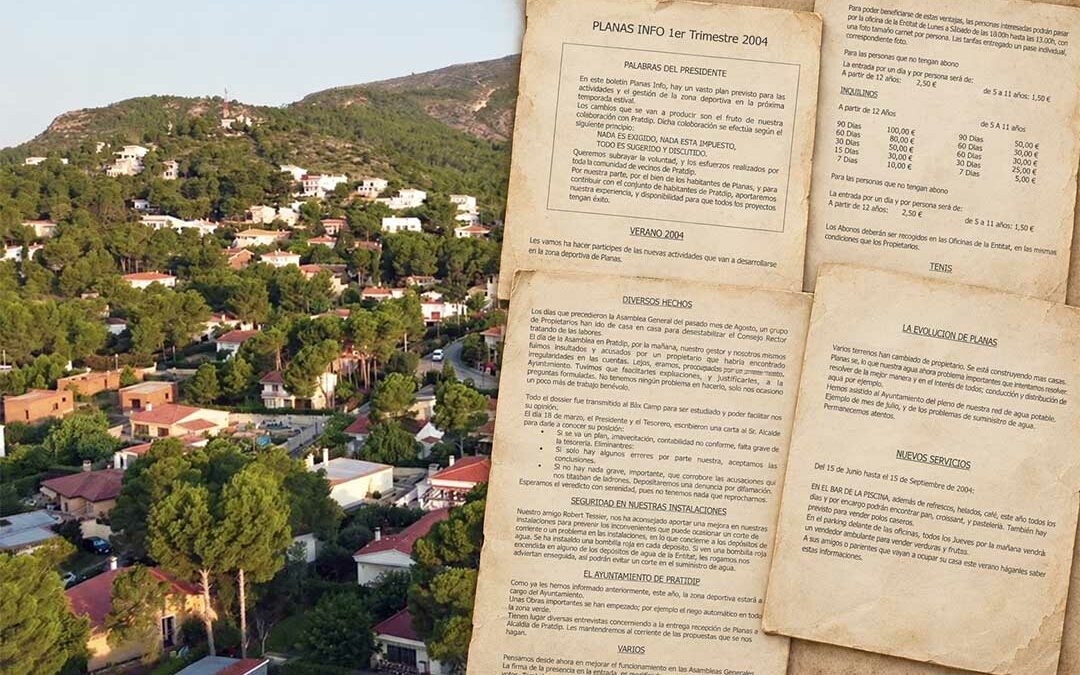
- Planas Info for the first quarter of 2004, in Spanish;
- Minutes of the general meeting of 14 August 2004, in Spanish.