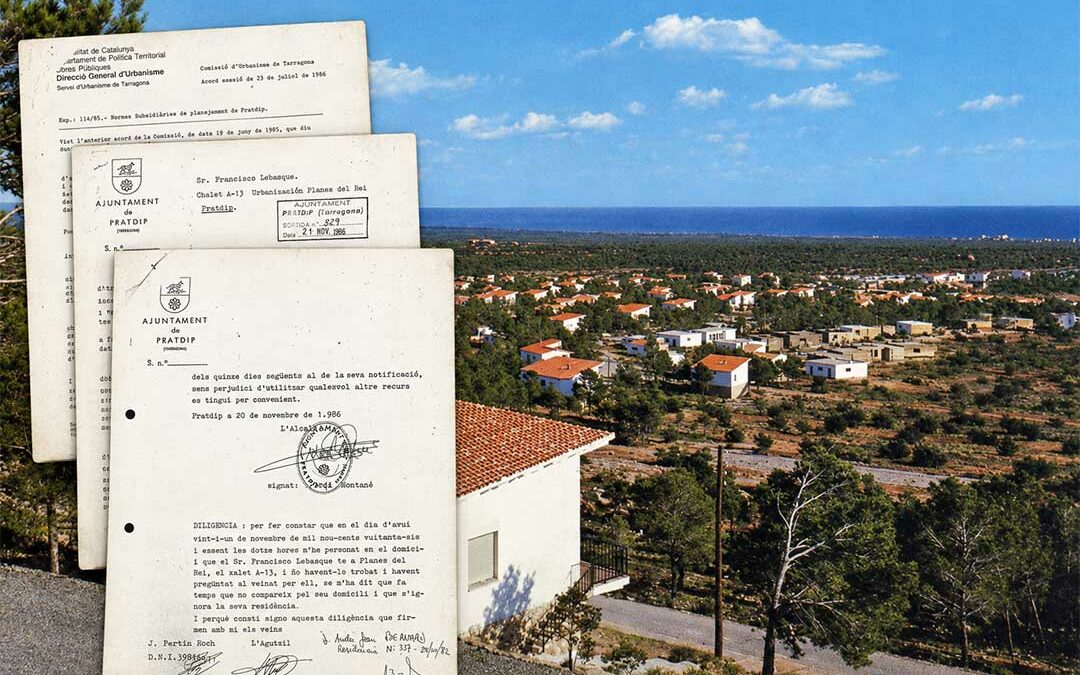
In July 1986, more than twenty years after the approval of the Planas del Rey Partial Plan and almost nine years after Francisco Lebasque submitted a new donation proposal, the transfer of the roads, green spaces and certain infrastructure once again came to the fore.
The Tarragona Urban Planning Commission then set a three-month deadline for formalising the compulsory transfers, free of charge, required under planning legislation. However, the steps taken between 1986 and 1988 quickly revealed several difficulties: the land did not belong to the property owners’ association, Francisco Lebasque could no longer be located, and the Town Council had to find a procedure that would allow the properties concerned to be registered in its name.
These documents help explain why, despite several administrative decisions and a stated intention to regularise the situation, the transfer still could not be brought to completion.
A process initiated in 1976
The attempted transfer that reappears in the 1986 documents did not begin that year. At their general meeting on 3 August 1976, the property owners of Planas del Rey approved negotiations with Pratdip Town Council for the gradual takeover of several essential services: the road network, the drinking-water supply, wastewater disposal, public lighting, waste collection and certain responsibilities relating to public health and safety.
On 28 October 1977, Francisco Lebasque took this process a step further by proposing to transfer the development’s main communal infrastructure to the municipality free of charge. He declared himself available to sign the necessary deeds and requested that the donation take effect on 1 January 1978.
However, the available documents do not establish whether this donation was formally accepted, notarised and registered in the municipality’s name. When the matter resurfaced in 1986, the transfer envisaged almost ten years earlier had therefore still not been formalised.
In 1986, a new three-month deadline
On 23 July 1986, the Tarragona Urban Planning Commission granted final approval to the consolidated version of Pratdip’s Subsidiary Planning Regulations.
Among the provisions imposed was the requirement to include in the regulations the deadlines applicable to the compulsory transfers, free of charge, concerning the developments of Planas del Rey, Pinares Tarraco and Santa Marina.
The decision stipulated that these transfers had to be formalised and completed in favour of the Town Council within a maximum period of three months from the final approval of the Regulations.
On 25 August 1986, the Town Council notified the Planas del Rey property owners’ association of this decision. It asked the association to formalise by public deed the compulsory transfers, free of charge, of the green spaces and facilities provided for in the Partial Plan.
However, this request immediately encountered a fundamental difficulty: the property owners’ association did not own the land concerned.
The land was still registered in Francisco Lebasque’s name
In July 1986, a lawyer from Reus informed the property owners’ association of the information obtained from the Falset Land Registry concerning property 1331.
This property, which included the swimming pools, changing rooms, five tennis courts, miniature golf course, gardens and children’s playground, was still registered in the name of Francisco Lebasque.
The Land Registry also indicated that the property was subject to suspension-of-payments proceedings. This situation inevitably complicated any transfer operation.
On 20 November 1986, the property owners’ association formally replied to the Town Council. It pointed out that the land in Planas del Rey was registered in Francisco Lebasque’s name and stated that the association itself did not own any of the properties concerned.
It was therefore unable to carry out the requested transfers: these had to be completed by Francisco Lebasque or, in view of his financial situation, by his legal representatives.
The Town Council attempts to locate Francisco Lebasque
On 20 November 1986, the Town Council sent a formal notice to Francisco Lebasque at his last known address, chalet A-13 in Planas del Rey.
It asked him to provide his title deeds and the necessary plans so that the transfer of the land required under planning legislation could be formalised before a notary.
However, on 21 November 1986, a municipal report recorded that Francisco Lebasque could not be found at that address. After making enquiries among the neighbours, the municipal official stated that he had not lived there for some time and that his current address was unknown.
The Town Council subsequently published a notice in the Official Gazette of the Province of Tarragona on 27 December 1986. Francisco Lebasque did not respond to this notification either.
The Town Council considers drawing up an occupation record
On 17 January 1987, the Town Council informed the Tarragona Urban Planning Commission that the developer’s whereabouts were unknown and that he had not responded to the notice published in the Official Gazette.
Considering it unlikely that he would appear, the Town Council proposed drawing up an occupation record for the land subject to compulsory transfer. It asked the authorities whether this procedure would be sufficient to comply with the decision of 23 July 1986.
The Directorate-General for Urban Planning replied on 19 May 1987. It explained that the essential objective was not merely to record the occupation of the land, but to enable the municipality’s title of acquisition to be entered in the Land Registry.
It therefore advised the Town Council to consult the Falset land registrar beforehand. It also stated that an occupation record could be used provided that several formalities were observed: the former developer had to be formally notified, substitute enforcement had to be provided for if he failed to appear and, if necessary, the Public Prosecutor’s Office had to intervene to represent the absent party.
Precisely identifying the land to be transferred
On 4 June 1987, the Town Council wrote to the Falset Land Registry to obtain the necessary information about the land included within the boundaries of the Partial Plan.
In particular, it requested an information note concerning Francisco Lebasque’s title of acquisition and the land that remained subject to compulsory transfer free of charge. The Town Council assumed that this consisted of the areas left after the successive subdivisions of the estate and the sale of the individual plots.
This step shows that the difficulty was not solely due to the developer’s absence. It was also necessary to identify the land concerned in legal and registration terms before it could be registered in the Town Council’s name.
What exactly had to be transferred to the Town Council?
The documents also reveal uncertainty about the precise scope of the compulsory transfers.
On 25 August 1986, the Town Council asked the property owners’ association to transfer the green spaces and facilities. However, in a report dated 7 September 1987, the municipal architect provided a different interpretation.
According to the architect, because the Partial Plan had been drawn up under the 1956 Land Act, it did not explicitly provide for the transfer of the facilities area. He therefore considered that the compulsory transfers should be limited to the green spaces and roads.
This difference is significant. It shows that, beyond the intention to regularise the situation, the authorities still had to determine precisely which land was subject to compulsory transfer and which required another form of conveyance.
The EUCC is created during these proceedings
Alongside the steps taken to formalise the transfers, the Town Council organised the conservation and management of the development.
On 24 July 1987, the municipal council decided that the Planas del Rey property owners should become subject to a conservation entity. The deed establishing the Collaborative Urban Conservation Entity, or EUCC, was signed a few days later, on 28 July 1987.
Its articles of association included the maintenance and improvement of the roads, green spaces, public lighting and other shared elements among its functions. They also referred to the possible completion of the outstanding shared works.
However, the creation of this entity did not mean that the transfers had been completed. Its primary role was to organise the maintenance of the development and the compulsory participation of the property owners while the land-registration and administrative situation remained to be regularised.
On 12 April 1988, the Town Council formally approved the deed establishing the EUCC, on the condition that the compulsory transfers provided for under the Land Act be arranged in its favour within a maximum period of two years. This decision is examined in a separate article on the creation of the Planas del Rey EUCC.
The Town Council turns to Francisco Lebasque’s creditors
After its attempts to deal directly with Francisco Lebasque proved unsuccessful, the Town Council approached the creditors’ committee established as part of his suspension-of-payments proceedings.
On 15 January 1988, it asked his legal representatives to formalise the compulsory transfers, free of charge, relating to Planas del Rey.
On 13 April 1988, the Town Council once again recorded that the transfers of the roads, green spaces and facilities required by law had still not been completed.
It also recalled that, in his letter of 28 October 1977, Francisco Lebasque had undertaken to transfer several areas of land and services to the Town Council. This 1977 donation proposal had therefore failed to regularise the situation definitively.
The Town Council then required the creditors’ committee to appear before a notary in Reus to formalise the permanent transfers, free of charge, in the name of Pratdip Town Council.
Proceedings initiated, but still incomplete
The documents from 1986 to 1988 show that Pratdip Town Council took several concrete steps to obtain the land subject to compulsory transfer.
They also reveal the obstacles encountered:
- the property owners’ association did not own the land concerned;
- the land was still registered in Francisco Lebasque’s name;
- the developer could no longer be located at his last known address;
- his assets were subject to suspension-of-payments proceedings;
- the land to be transferred had to be precisely identified;
- its registration in the Town Council’s name required a legally valid procedure;
- the exact scope of the compulsory transfers did not yet appear to have been clearly established.
The creation of the EUCC addressed the immediate need to maintain and manage the development, but it did not automatically resolve the question of ownership of the roads, green spaces and facilities.
By the end of this documentary sequence, the Town Council had reaffirmed its intention to obtain the transfers and had approached Francisco Lebasque’s legal representatives. However, the available documents do not establish whether the notarial deeds were ultimately signed or whether all the land concerned was registered in the Town Council’s name.
The transfer therefore remained incomplete, while the EUCC gradually assumed a maintenance role that would continue far beyond the two years initially envisaged.
Jim – La Tribune de Planas
Reference documents
View the information obtained from the Land Registry in July 1986
View the Urban Planning Commission’s decision of 23 July 1986
View the notice sent by the Town Council to the property owners’ association on 25 August 1986
View the property owners’ association’s reply of 20 November 1986
View the formal notice sent to Francisco Lebasque and the municipal report of 21 November 1986
View the Town Council’s letter to the Urban Planning Commission of 17 January 1987
View the Directorate-General for Urban Planning’s reply of 19 May 1987
View the request sent to the Falset Land Registry on 4 June 1987
View the municipal architect’s report of 7 September 1987
View the formal notice sent to the creditors’ committee on 15 January 1988
View the request to appear before a notary dated 13 April 1988