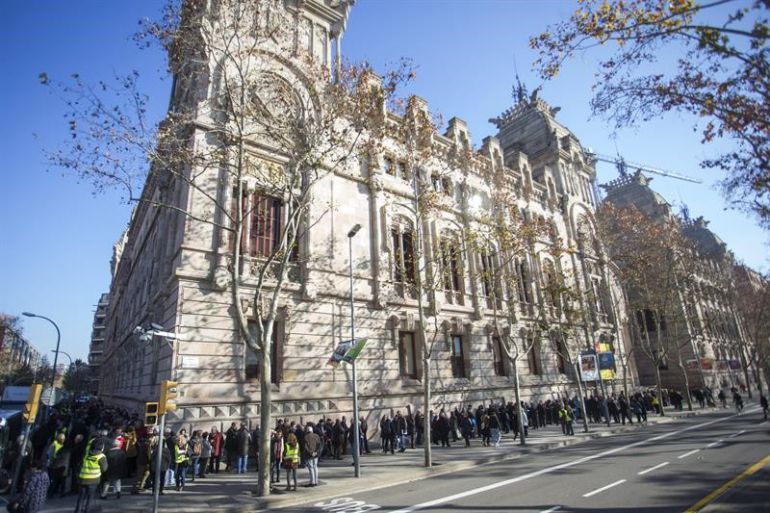
On 21 July 2016, the High Court of Justice of Catalonia (TSJC) delivered a landmark judgment in Barcelona in the history of Planas del Rey: it declared the dissolution of the Urban Development Conservation Entity (EUCC).
The decision came three years after the judgment delivered by the Tarragona court on 26 March 2013, which had refused to dissolve the entity.
The proceedings had been brought by several property owners in Planas del Rey. They were members of the SOS Planas association, which had supported the campaign to dissolve the EUCC for several years.
From a legal perspective, however, it was the property owners themselves who appeared as the claimants in the proceedings.
Following the unfavourable judgment in 2013, they lodged an appeal. The TSJC ultimately ruled in their favour on this essential issue.
In simple terms: in 2013, the court considered that the EUCC had to continue to exist because Planas had not yet been completed or formally handed over to the Town Council. In 2016, the TSJC ruled that this situation could not justify extending indefinitely the maintenance obligation imposed on the property owners.
Why had the Tarragona court refused to dissolve the EUCC?
In 2013, Administrative Court No. 1 of Tarragona had found that the urban development works were not complete and that Planas del Rey had not been formally handed over to Pratdip Town Council.
For that court, the situation still justified keeping the EUCC in place.
It had also considered that the rule limiting certain maintenance obligations to five years could not lead to the dissolution of the EUCC while the development works remained unfinished.
The property owners challenged precisely this interpretation before the TSJC.
The TSJC adopts a different interpretation
The High Court of Justice of Catalonia reconsidered this part of the 2013 judgment.
It examined the transitional provision of Legislative Decree 1/1990 on Catalan urban-planning law.
Under this provision, when property owners are required to conserve and maintain a residential development, that obligation cannot continue for more than five years.
The decree came into force on 13 July 1990.
The TSJC found that, by the time it delivered its judgment, the five-year period had long since expired.
It therefore reached a different conclusion from the Tarragona court: the fact that Planas remained unfinished did not allow this obligation to be imposed on the property owners indefinitely.
In simple terms: a situation intended to be temporary cannot become permanent simply because the works and the formal handover of the development have still not been completed.
The TSJC declares the dissolution of the EUCC
The court’s final decision is very clear.
The TSJC partially upheld the property owners’ appeal and overturned the part of the 2013 judgment concerning the dissolution.
It upheld their challenge against the rejection, through administrative silence, of their request and declared the dissolution of the EUCC of Planes del Rei.
The judgment also states that it is final and that no appeal on points of law may be lodged.
Had the EUCC therefore been dissolved since 1995?
An important distinction must be made here.
The TSJC did find that the maximum five-year period laid down by the legislation had been exceeded long before.
However, it did not state that the EUCC had automatically ceased to exist in 1995.
The judgment delivered on 21 July 2016 declared its dissolution following the appeal brought by the property owners.
It would therefore be incorrect to claim that all the EUCC’s activities since 1995 had automatically lacked any legal basis for that reason alone.
In simple terms: the legal time limit had long since expired, but it was the TSJC that declared the dissolution of the EUCC in its 2016 judgment.
An important victory, but on a specific issue
The property owners had made several requests in the proceedings initiated in 2010.
The TSJC ruled in their favour on the fundamental issue of the dissolution of the EUCC.
However, it did not overturn the entire 2013 judgment.
In its final decision, the court stated that the other parts of the first-instance judgment that were not affected by its ruling remained in force.
This means, in particular, that the judgment should not be presented as a decision that, by itself, required the Town Council immediately to take responsibility for all the services and infrastructure in Planas del Rey.
Its significance is already considerable: it brought the EUCC to a legal end by declaring its dissolution.
Why is this judgment so important in the history of Planas?
The statutes drawn up in 1987 made membership of the EUCC compulsory for all property owners within the boundaries of Planas del Rey and stated that the entity was established for an indefinite period. For almost thirty years, the property owners funded the upkeep and maintenance of much of the development’s infrastructure through the EUCC.
For SOS Planas, which had supported and accompanied the initiative, the decision also marked the culmination of several years of opposition to the continued existence of the EUCC.
The EUCC’s continued existence had long been linked to the fact that Planas del Rey remained unfinished and had not yet been formally handed over to the Town Council.
The judgment of 21 July 2016 changed that reasoning.
The TSJC ruled that the unfinished state of the development could not justify extending indefinitely a maintenance obligation that the legislation had intended to be temporary.
This is what makes the decision a major turning point in the administrative history of Planas del Rey.
What should be remembered
The history can ultimately be summarised quite simply:
- several property owners ask for the EUCC to be dissolved;
- in 2013, the Tarragona court refuses to dissolve it because Planas is unfinished and has not been formally handed over to the Town Council;
- the property owners appeal;
- the TSJC rules that the maintenance obligation could not be extended indefinitely;
- on 21 July 2016, it declares the dissolution of the EUCC of Planes del Rei;
- the other parts of the 2013 judgment that are not affected by the decision remain in force.
In simple terms: in 2013, the unfinished state of Planas had been used to justify keeping the EUCC in place. In 2016, the TSJC ruled that this argument could no longer be used to extend indefinitely an obligation imposed on the property owners.
The dissolution of the EUCC opened a new chapter in the history of Planas del Rey: it remained to be determined how the judgment would be implemented and how the development’s services and management would be organised following the disappearance of the entity.
Jim – La Tribune de Planas
Translation of the key passages of the judgment
On the five-year limit
From the entry into force of Legislative Decree 1/1990, on the date of its publication in the DOGC on 13 July 1990, the property owners’ obligation to conserve and maintain the development could not continue for more than five years.
As this period had long since expired, the court considered that the appeal concerning the request to dissolve the Urban Development Conservation Entity should be upheld.
On the TSJC’s decision
The High Court of Justice of Catalonia partially upheld the property owners’ appeal and partially overturned the judgment delivered by Administrative Court No. 1 of Tarragona.
It upheld the challenge against the rejection, through administrative silence, of the request to dissolve the Urban Development Conservation Entity of Les Planes del Rei and declared the dissolution of the entity.
On the other parts of the judgment
The other rulings contained in the first-instance judgment that were not affected by this decision remained in force.
On the final nature of the judgment
The judgment is final and no appeal on points of law may be lodged.