On 7 September 2026, the Butlletí Oficial de la Província de Tarragona (BOPT) published Pratdip’s new municipal regulations governing drinking water supply and sewerage services.
Finally approved by the Town Council on 21 August, following a public consultation period during which no objections were submitted, this 103-page document sets out the respective obligations of the Town Council and service users.
Several provisions deserve particular attention from property owners in Planas del Rey. They concern water outages, network maintenance, responsibility for repairs, the location of water meters and connections to the sewerage system.
Different from the tax ordinance adopted in July
These regulations should not be confused with the tax ordinance that came into force on 1 July 2026.
The tax ordinance mainly establishes water charges, standing charges and billing arrangements. The new regulations, by contrast, govern how the service operates and define the rights and obligations of both the Town Council and service users.
The two documents are therefore complementary: the first determines what subscribers must pay, while the second explains how the service must be organised.
The Town Council is directly responsible for the service
The regulations confirm that drinking water supply and sewerage are essential municipal services. They are managed directly by Pratdip Town Council, although certain technical operations may be entrusted to a specialist company.
In particular, the Town Council must:
- maintain water pressure and flow in accordance with the applicable standards;
- guarantee the sanitary quality of the water up to the delivery point;
- ensure that the service remains available and reliable;
- maintain and repair reservoirs, the public network and external service connections;
- provide a permanent service for reporting faults and incidents.
Any company responsible for maintenance therefore operates under the authority of the Town Council. For service users, Pratdip Town Council remains the public authority responsible for the service.
Water supply interruptions are now regulated
The regulations state that the water supply should normally be provided continuously. However, interruptions may occur to carry out repairs, maintain installations, deal with drought conditions or respond to exceptional circumstances affecting water quality.
When an interruption can be anticipated and is scheduled in advance, the Town Council must notify users at least 24 hours beforehand and indicate its estimated duration.
When an interruption affects a large number of people, the information must also be circulated through one of the communication channels most widely used in the municipality.
The regulations also specify that a temporary interruption should not normally last longer than 12 hours, except in cases of force majeure or circumstances beyond the Town Council’s control.
This provision is particularly significant for Planas del Rey, where several areas experienced prolonged water outages during the summer of 2026.
The document nevertheless states that users are not entitled to claim compensation for damage resulting from these temporary interruptions.
Where does the Town Council’s responsibility end?
The regulations draw a distinction between the public network and private installations.
The Town Council is responsible for the distribution network, the external service connection and the stop valve located at the property boundary. The property owner is responsible for the internal installation, from that boundary to the taps inside the home.
Property owners must therefore maintain their private pipework and repair any leaks occurring beyond the delivery point.
If a property does not receive sufficient water pressure because of its elevation or configuration, the regulations also require the owner to install, at their own expense, equipment capable of increasing the pressure.
Water meters must be accessible
One of the provisions likely to have the most practical consequences concerns the location of water meters.
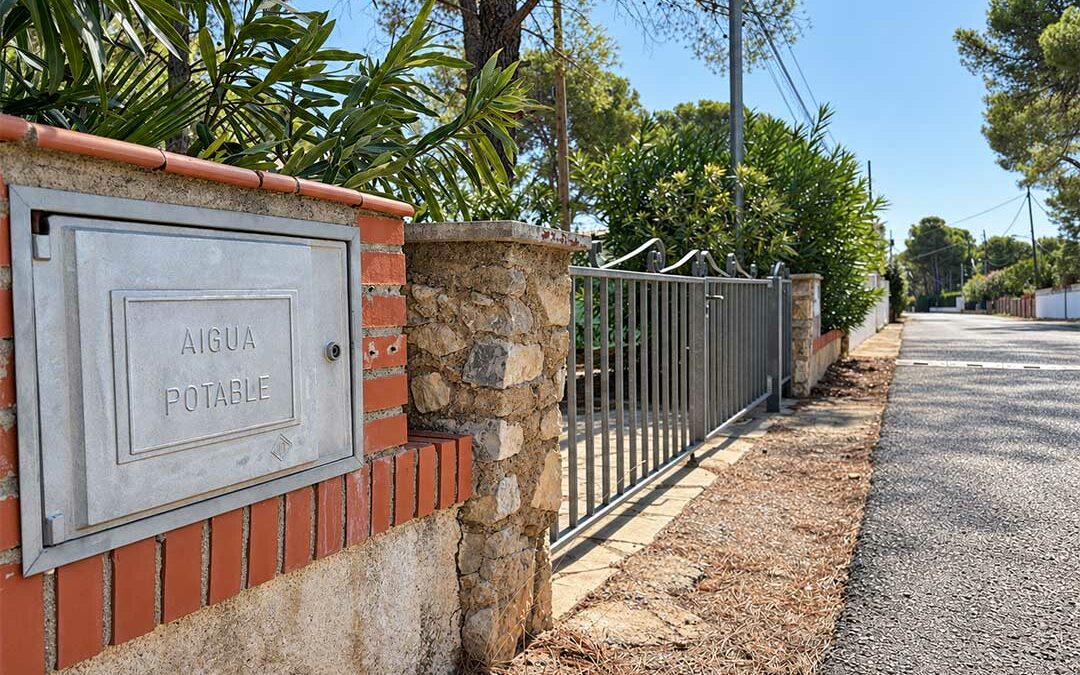
The regulations state that meters must be installed in an inspection chamber, cabinet or room located in a freely accessible area. The technical diagrams appended to the document show two main configurations: installation in a cabinet on the building’s façade or in an inspection chamber at the boundary of the plot.
The purpose is to allow the meter to be read, inspected, maintained and replaced without having to enter the property.
This provision could affect many older installations in Planas del Rey. On some properties, the water connection or meter may be buried within a neighbouring plot or located somewhere that is difficult to access.
The regulations state that when an installation does not meet these requirements, the cost of relocating the meter must be borne by the subscriber.
However, they do not establish a general deadline requiring all property owners to relocate their meters immediately. Nor do they explain how older configurations inherited from the historic Planas del Rey network will be dealt with.
Several questions therefore remain unanswered: will the Town Council require all non-compliant installations to be modified? Who will determine what work is necessary? And who will have to pay when an existing installation crosses a neighbouring property or results from the way the original network was designed?
Installation on the building façade
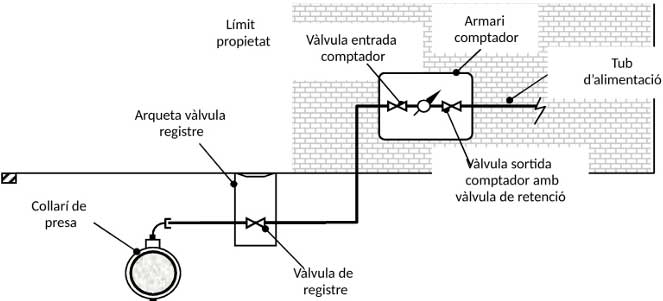
Installation at the boundary of the plot
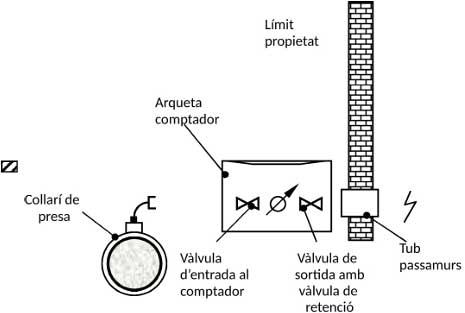
Source: Pratdip Town Council – Municipal regulations, Annex I
Adjusted billing in the event of an accidental leak
The regulations establish a specific procedure when abnormally high consumption results from an accidental leak that cannot be attributed to negligence on the part of the property owner.
To request a billing adjustment, the user must have the leak repaired and provide supporting documentation issued by an authorised installer. The Town Council may also investigate the cause of the incident.
The volume of water attributable to the leak may then be billed using a specific method, rather than the standard tariff applied to normal consumption.
Connection to the sewerage system
The second part of the document concerns the municipal sewerage service.
The regulations state that any building located alongside a public sewer must be connected to it. When a public sewer exists within 100 metres, the Town Council may extend it, but the cost must be borne by the property owner or owners concerned.
The Town Council must maintain the existing public sewer network, ensure the reliability of the service and provide a permanent facility for reporting sewerage-related incidents.
These provisions nevertheless raise a particular issue in Planas del Rey. Because of the layout of the development, some properties have never been connected to the sewer network leading to the wastewater treatment plant. Some homes built after 2000 that could not be connected to this network were also fitted with septic tanks. The regulations therefore describe the normal operation of a communal sewerage system, whereas the treatment plant has been out of service since 2017 and individual properties may have different drainage arrangements.
No immediate new sewerage charge for Planas del Rey
The regulations establish the general principle that users of the sewerage service may be required to pay a charge, including when they fail to connect despite being legally required to do so.
This does not mean that property owners in Planas del Rey are immediately subject to a new sewerage charge.
The tax ordinance that came into force on 1 July 2026 currently states that this charge applies to subscribers in Pratdip, but not to those in Planas del Rey. The tax ordinance would therefore have to be amended for this situation to change.
A general framework, but several questions remain for Planas
The new regulations establish the general rules governing drinking water and sewerage services throughout the municipality. They clarify the responsibilities of the Town Council and service users, as well as the normal operating conditions of both services.
However, their practical application in Planas del Rey still needs to be clarified.
In particular, it remains to be seen:
- whether the Town Council intends to inspect or relocate meters that are currently difficult to access;
- how installations crossing neighbouring properties will be dealt with;
- who will bear the cost of bringing installations linked to the old network into compliance;
- what the exact status of the Planas del Rey sewerage network is;
- how the sewerage requirements can be applied while the wastewater treatment plant remains out of service;
- from what date all the provisions of the regulations will become fully applicable.
The regulations therefore provide a clearer legal framework, but they do not resolve the structural problems affecting the Planas del Rey network. As with the tax ordinance published in July, the administrative arrangements are changing more quickly than the infrastructure itself.
Jim – La Tribune de Planas
Reference documents
For readers wishing to consult the full document:
Pratdip municipal regulations governing drinking water supply and sewerage services — full document in PDF format (PDF, 103 pages)