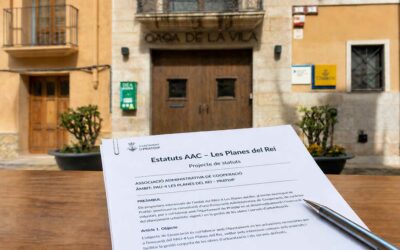
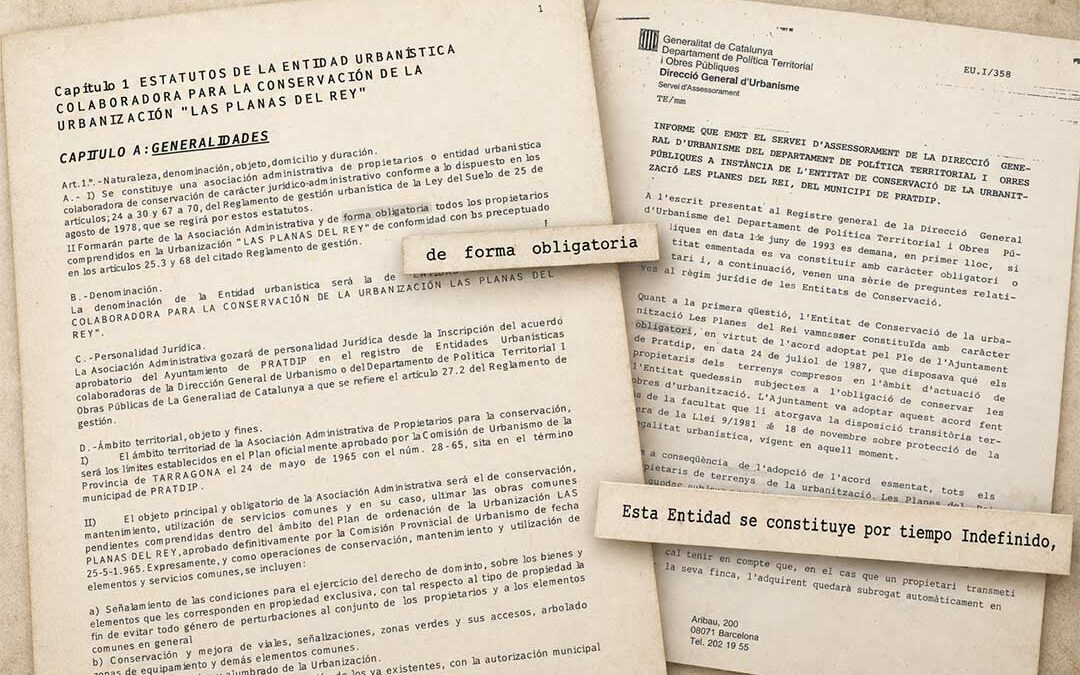
In 1987, the statutes of the Planas del Rey Urban Development Conservation Entity defined how the EUCC would operate, its responsibilities and the obligations of its members.
Above all, they established that the EUCC was not an association that property owners could freely choose whether or not to join. Anyone who owned a plot within its boundaries was required to be a member and contribute towards its expenses.
However, these documents raise an issue that would eventually prove decisive: while the statutes established an entity of indefinite duration, the legislation invoked to make property owners responsible for maintaining the development limited this obligation in time.
An entity established in several stages
According to a report issued by the Generalitat in 1993, Pratdip Town Council decided on 24 July 1987 to establish the EUCC on a compulsory basis. Property owners within its boundaries were therefore made responsible for maintaining the development works.
The deed of incorporation, to which the statutes were attached, was signed on 28 July 1987. On 6 August, the notary Inmaculada Nieto Aldea certified that the copies were faithful reproductions of the documents attached to the deed.
The statutes nevertheless specified that the entity would not acquire legal personality until the municipal resolution approving it had been entered in the Generalitat’s Register of Collaborative Urban Development Entities.
On 12 April 1988, Pratdip Town Council approved the EUCC’s deed of incorporation and also requested that the compulsory transfers to the municipality be arranged within a maximum period of two years.
An obligation attached to property ownership
Membership did not depend on whether a property owner had participated in establishing the entity or had been included in its deed of incorporation.
When a plot was sold, the buyer automatically assumed the former owner’s rights and obligations. This is why people who purchased their properties after 1987 were also bound by the statutes and required to pay the contributions approved by the EUCC.
Maintaining the infrastructure and completing outstanding works
The EUCC’s main responsibility was to ensure the preservation, maintenance and use of Planas del Rey’s communal services and facilities.
Under the statutes, its responsibilities included:
- maintaining and improving the roads and signage;
- maintaining the green spaces, access routes, planted areas and land reserved for facilities;
- managing the development’s electricity supply and public lighting;
- creating or extending communal services, with the Town Council’s authorisation;
- representing property owners before public authorities and the courts;
- and, where necessary, completing any outstanding communal works.
This last responsibility shows that, when the EUCC was established, the statutes already recognised that some of Planas del Rey’s infrastructure might still need to be completed.
Expenses funded by property owners
The EUCC’s expenses were to be covered by the property owners. Each owner’s contribution was calculated according to the surface area of their plot in relation to the development’s total area.
A specific coefficient applied to supermarkets and restaurants, whose contributions were to be multiplied by three.
The statutes considered that the entity’s services benefited all property owners. None of them could therefore choose to withdraw from the EUCC or refuse to pay contributions that had been duly approved.
In the event of non-payment, the statutes provided for late-payment interest and various recovery procedures. The Governing Council could, in particular, ask Pratdip Town Council to recover outstanding amounts through administrative enforcement proceedings.
The statutes also provided for the suspension of certain services and even the interruption of the water supply. The document establishes that such measures were envisaged in 1987, but does not indicate under what circumstances they could legally be applied or whether they were ever actually enforced.
An entity administered by the property owners
The EUCC was governed by a General Assembly and a Governing Council elected by the Assembly.
The General Assembly approved, among other matters, the accounts, the annual budget and the contributions payable by property owners. The Governing Council implemented its decisions, administered the communal areas and services, commissioned the necessary works and represented the entity before the Town Council and other public authorities.
EUCC decisions governed by administrative planning law could be appealed before Pratdip Town Council. The entity therefore did not operate as a straightforward private association, but as a body working with the municipal authority to maintain the development.
Statutes providing for an indefinite duration
The statutes stated that the EUCC was established for an indefinite period. This meant that no automatic end date was set, but it did not make the entity incapable of being dissolved.
Its dissolution could be requested by half of the votes represented in the General Assembly and had to be approved by the Town Council. The statutes added that dissolution could not take place while obligations remained outstanding or until the municipality had assumed responsibility for maintaining the communal facilities.
The text therefore established a direct link between the continuation of the EUCC, the completion of its responsibilities and the Town Council’s assumption of maintenance duties.
But the law limited the maintenance obligation to five years
The indefinite duration established by the statutes must, however, be considered alongside the legislation on which the Town Council relied to impose the maintenance obligation on property owners.
The third transitional provision of Catalan Law 9/1981 on the protection of planning legality allowed a town council to make property owners temporarily responsible for maintaining a development when the works had not been completed in accordance with the approved project, it was no longer possible to require the developer to complete them and certain other conditions had been met.
This provision specified that the obligation imposed on property owners could not last for more than five years. During that period, the Town Council was required to take the necessary measures to enable it to assume this responsibility afterwards.
The Generalitat’s 1993 report expressly states that the municipal decision of 24 July 1987 establishing the compulsory nature of the EUCC was based on this provision of the 1981 law.
A difficulty therefore existed from the outset: the statutes created an entity of indefinite duration, while the law invoked to impose maintenance responsibilities on property owners required this obligation to remain temporary.
In 1993, the Generalitat confirms the interpretation of the statutes
On 1 June 1993, the EUCC asked the Generalitat’s Directorate-General for Urban Planning about its legal status and, in particular, whether membership was compulsory or voluntary.
The advisory service replied that this obligation arose from the decision adopted by Pratdip Town Council on 24 July 1987 and from the applicable legislation. Participation in the deed of incorporation or the individual consent of a property owner was therefore not decisive.
However, the surviving copy of this report consists of only one page and ends in the middle of the explanation concerning the transfer of property ownership. It confirms the compulsory nature of the EUCC but does not reveal the Generalitat’s complete response to the other questions it had been asked.
In particular, it does not indicate how the administration interpreted the coexistence of the indefinite duration established by the statutes and the five-year legal limit applicable to the maintenance obligation.
A contradiction finally settled in 2016
This difficulty remained unresolved for many years. The fact that Planas del Rey was unfinished and had not been fully accepted by the Town Council was long used to justify the continued existence of the EUCC.
Several property owners, supported in their efforts by SOS Planas, eventually sought its dissolution. After an initial unfavourable ruling in 2013, they appealed to the High Court of Justice of Catalonia.
In its judgment of 21 July 2016, the High Court of Justice of Catalonia ordered the dissolution of the Planas del Rey EUCC. It relied on the seventh transitional provision of Catalan Legislative Decree 1/1990, which had retained the maximum five-year limit.
The Court took 13 July 1990, the date on which this legislation came into force, as its starting point. It held that the unfinished state of the development could not justify indefinitely extending a maintenance obligation that the law had designed to be temporary.
However, the expiry of this period did not automatically cause the EUCC to cease to exist in 1995. It was the High Court of Justice of Catalonia that legally ordered its dissolution in 2016, following the appeal brought by the property owners.
Nor did this dissolution mean that the Town Council automatically accepted all of Planas del Rey’s infrastructure. It brought the entity and its maintenance obligation to an end, but did not by itself resolve the questions surrounding land ownership, the condition of the facilities and the works that still needed to be carried out.
What the 1987 and 1993 documents reveal
These documents reveal the origin of a dispute that would last for almost thirty years: an obligation that was legally temporary was organised through statutes establishing an entity with no end date.
This contradiction would not finally be settled until 2016, when the High Court of Justice of Catalonia ordered the dissolution of the EUCC.
Jim – La Tribune de Planas
Reference documents
Read the statutes of the Planas del Rey EUCC, authenticated on 6 August 1987
Read the Generalitat’s report confirming the compulsory nature of the EUCC in 1993