In February 2019, La Tribune de Planas informs property owners that they may ask the Falset Land Registry to remove certain urban-planning charges linked to the economic reparcelación project for Planes del Rei.
At the time, the situation is presented in fairly simple terms: an “urban-planning debt” would have been registered against properties in 2012 and the project would later have been cancelled by the Land Registry in May 2018, without the debt disappearing automatically.
The documents recovered since then allow this history to be described more accurately. The reparcelación was indeed administratively validated in 2012, but its registration at the Land Registry encountered several obstacles. As for 4 May 2018, this date appears to correspond to the expiry of a registry entry linked to the procedure, rather than to the cancellation of the reparcelación itself.
In simple terms: three separate issues must be distinguished: the administrative decision adopting the reparcelación, its registration at the Land Registry and any charges or entries appearing against an individual property.
2012: an economic reparcelación project for Planes del Rei
The economic reparcelación project for PAU-4 Planes del Rei is drawn up at the request of Pratdip Town Council.
A first version is adopted at the beginning of 2012. However, the Town Council identifies an important element missing from the file: the provisional liquidation account, intended to establish how the economic consequences of the operation are to be allocated among the affected properties.
The Town Council therefore restarts the procedure on 15 March 2012 and opens a new public consultation period.
A large number of objections are subsequently submitted by property owners and other affected individuals or organisations.
After considering them, the Town Council gives final approval to the economic reparcelación project on 11 July 2012. The decision provides, among other things, for the project to be sent to the Falset Land Registry so that it can be registered once it becomes enforceable.
The municipal decision is not enough for registration at the Land Registry
An important distinction then emerges between the administrative procedure conducted by the Town Council and the registration procedure.
The project validated in July is submitted to the Falset Land Registry, but its registration receives a negative qualification on 28 December 2012.
Later municipal documents indicate that several issues have to be corrected, particularly the description and boundaries of certain properties and the notifications sent to some owners registered at the Land Registry.
The 2012 reparcelación therefore remains a final administrative decision, but the document submitted cannot be registered in its existing form at the Land Registry.
A second version is prepared to enable registration
Following this negative qualification and discussions with the Falset Land Registry, the Town Council begins correcting the file.
A second consolidated version is initially adopted on 15 April 2015. Its purpose is, among other things, to resolve the difficulties encountered when attempting to register the 2012 version.
After further notifications, objections and corrections, the Town Council gives final validation to this second consolidated version on 4 January 2018.
The decision once again provides for the project to be sent to the Falset Land Registry. It is published in the Official Gazette of the Province of Tarragona on 16 March 2018.
11 April 2018: the Supreme Court confirms the 2012 decision
Meanwhile, the Association of Residents of Les Planes del Rei had challenged the validity of the reparcelación before the courts.
One of its arguments was that the final decision of 2012 had never really existed, in particular because the project had not been registered at the Falset Land Registry.
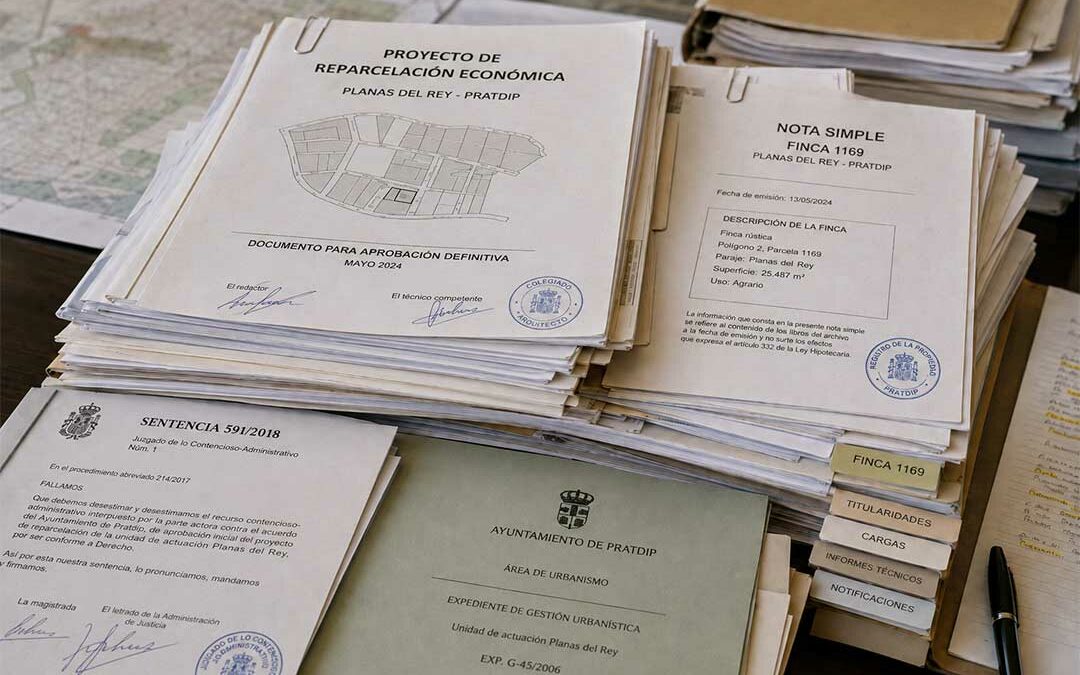
In Judgment 591/2018 of 11 April 2018, the Spanish Supreme Court rejects this argument.
The Court clearly distinguishes between two successive procedures:
- the first ended with the final approval of the economic reparcelación on 11 July 2012;
- the second was intended to modify the project in order to overcome the obstacles encountered when attempting to register it at the Land Registry.
The Supreme Court therefore considers that the absence of registration of the 2012 project does not mean that the administrative decision had never existed.
The Court rejects the review application brought by the association.
What, then, does the date of 4 May 2018 mean?
The former La Tribune article stated that “the registration of the reparcelación project” had been cancelled by the Land Registry on 4 May 2018.
The documents recovered since then allow this statement to be qualified.
A Land Registry extract dated 20 March 2018 concerning property 1169 refers to a marginal entry linked to a certificate issued as part of the reparcelación procedure.
This entry had been extended for a further three years on 4 May 2015.
4 May 2018 therefore very probably corresponds to the expiry of that extension.
This does not mean that the economic reparcelación itself was cancelled on that date. The expiry or removal of an entry at the Land Registry does not automatically cancel the administrative decision that gave rise to the procedure.
In 2019, property owners are informed of a possible procedure
It is in this context that the article published on 2 February 2019, originally signed by Martine Belgeonne, informs property owners of a possible procedure before the Falset Land Registry.
The form circulated at the time allows, among other things, a certificate concerning a property and its charges to be requested. It is also possible to request the removal of certain charges that have expired.
The article states that the procedure cost €47.35 at the time and took approximately fifteen days.
However, this information relates to the procedure and fees communicated in 2019. It should not be regarded today as up-to-date information on the formalities, timescales or fees applied by the Falset Land Registry.
“Urban-planning debt” or urban-planning charge?
The expression “urban-planning debt” used in the former article could give the impression that the same debt had automatically been registered against every property in Planes del Rei.
The documents currently available suggest that greater precision is needed.
The economic reparcelación project did indeed include a provisional liquidation account and an allocation of the economic consequences of the operation among the affected properties.
However, the Land Registry position of each individual property must be examined separately.
It is therefore more accurate to refer to urban-planning charges or registry entries linked to the reparcelación rather than to an identical “urban-planning debt” automatically payable by every property owner.
What to remember
The documents now available allow the chronology to be reconstructed more accurately:
- in March 2012, the Town Council restarts the procedure in order to include, among other elements, the provisional liquidation account;
- on 11 July 2012, the economic reparcelación project receives final approval;
- on 28 December 2012, its attempted registration at the Falset Land Registry receives a negative qualification;
- a second consolidated version is subsequently prepared to correct the difficulties encountered;
- this new version receives final validation on 4 January 2018;
- in April 2018, the Supreme Court confirms the existence of the administrative decision adopted in 2012;
- certain registry entries linked to the procedure subsequently expire;
- in 2019, property owners are informed that they may request the removal of certain expired charges when these still appear against their property.
In simple terms: the economic reparcelación, its registration at the Land Registry and any charges appearing against an individual property are three separate issues. Making this distinction allows us today to understand more clearly what actually happened between 2012 and 2019.
La Tribune de Planas
Reference documents
- Second initial approval of the economic reparcelación project – 15 March 2012, in Catalan;
- Final approval of the economic reparcelación project – 11 July 2012, in Catalan;
- Final approval of the second consolidated version of the economic reparcelación project – 4 January 2018, in Catalan;
- Publication in the BOPT of the final approval of the second consolidated version – 16 March 2018, in Catalan;
- Land Registry extract for property 1169 at the Falset Land Registry – 20 March 2018, in Spanish;
- Spanish Supreme Court, Judgment 591/2018 – 11 April 2018, in Spanish.