For several months now, the possible creation of an Administrative Cooperation Association (AAC) has been regularly mentioned in discussions about the future of Planas del Rey.
Some property owners are already wondering what the future statutes of such an association might look like. Others are asking whether they should join it or not.
However, before even addressing these questions, many owners believe that several essential issues still need to be clarified.
Because before discussing how a possible AAC might operate, it is probably useful to understand exactly what project is being planned for the urbanization.
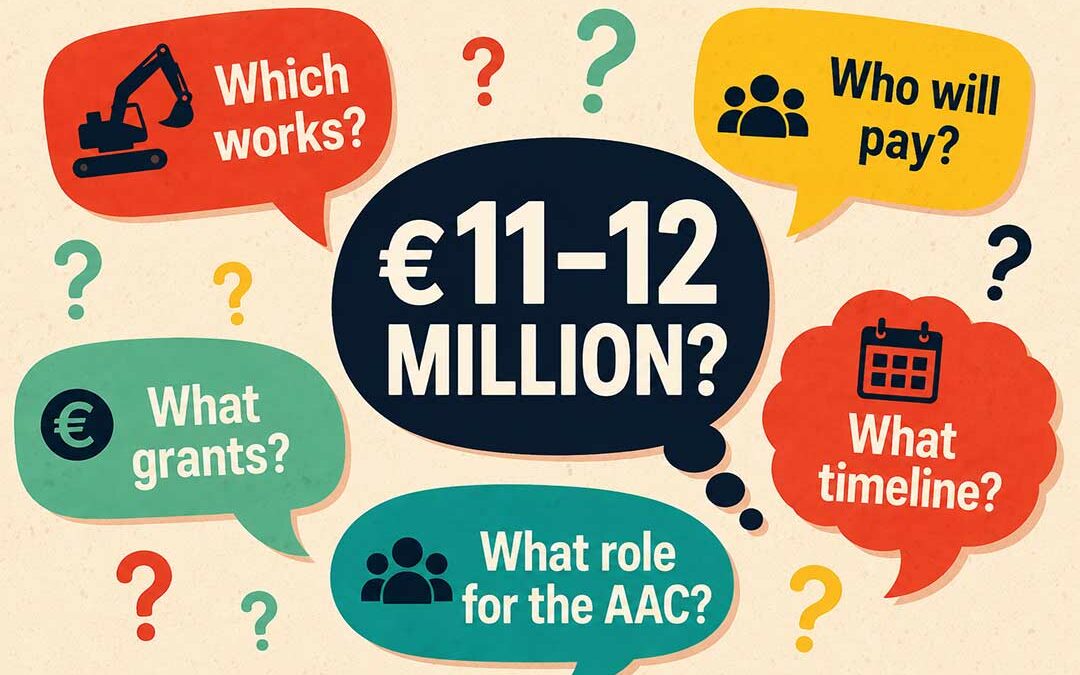
11 or 12 million euros: but for what works exactly?
For several years, different figures have circulated regarding the cost of upgrading the urbanization.
Amounts ranging from 11 to 12 million euros are regularly mentioned during meetings, discussions among property owners and exchanges with public authorities.
But one question keeps coming back:
What works do these 11 or 12 million euros actually represent?
The discussions mainly focus on:
- the drinking water network;
- the sewage system;
- the roads and streets;
- stormwater drainage;
- public lighting;
- certain shared infrastructures.
Yet at this stage, many property owners still do not know which specific works will ultimately be selected, which infrastructures will need to be replaced, which can be retained, and what improvements will be required by the various public administrations.
Is there currently a detailed technical project clearly identifying the planned works, their estimated cost and their possible implementation in phases?
This question is important because the final cost will depend directly on the nature and scope of the works that are ultimately carried out.
What will the actual cost of the works be?
Once the exact content of the project is known, another question naturally arises: what will its real cost be?
Do the figures mentioned so far correspond to a preliminary estimate or to a final budget approved by all the administrations involved?
Are adjustments still possible?
Do additional studies still need to be carried out?
To date, these elements do not appear to have been presented in detail to all property owners.
What share will be financed by the property owners?
This is probably the question that raises the most concerns.
Will property owners have to finance the entire project?
Will part of the cost be covered by the municipality?
Will other public administrations contribute financially?
The amount ultimately borne by property owners will depend directly on the answers to these questions.
What grants or subsidies may be obtained?
Over the past few months, several public funding mechanisms have been mentioned.
Various regional, provincial or European grants could potentially help reduce the overall cost of the project.
But which funding programs will actually be available?
What amounts could be obtained?
And above all, what impact will these subsidies have on the financial contribution requested from property owners?
Who will finance the works initially?
This question is often less visible, but it is nevertheless essential.
Even if property owners are expected to contribute financially, the works will need to be funded before any reimbursement takes place.
Who will advance the necessary funds?
- The Municipality of Pratdip?
- A public administration?
- A financial institution?
- Another entity?
At this stage, very little detailed information has been provided on this issue.
Who will repay the costs and under what conditions?
If a financial contribution from property owners is planned, several practical questions will also need to be clarified.
- Over how many years could payments be spread?
- What role will the public body BASE play in collecting the payments?
- What guarantees will be offered to property owners?
- What mechanisms will be available in the event of payment difficulties?
These issues will be of major importance to many families affected by the project.
What exactly will the role of the AAC be?
Only once the technical and financial aspects are better defined will it be possible to fully assess the role of a possible AAC.
Will it mainly act as a representative body for property owners?
Will it participate in the administrative monitoring of the project?
Will it oversee certain expenditures or the progress of the works?
A large part of these answers will depend on the statutes that may eventually be proposed to property owners.
Understanding before deciding
The reparcelación process continues to move forward administratively and legally.
At the same time, discussions about a possible AAC are gradually developing.
However, before deciding whether to support or oppose a future association, many property owners believe it is important to have a complete picture of the project: the planned works, their cost, how they will be financed and the participation that may be required.
Because before deciding how to organize a project, it is probably necessary to know exactly what that project is.
03/07/2026
Jim – La Tribune de Planas
Read also: Nearly 100 Catalan Mayors Call for Reform of Deficient Urbanisations