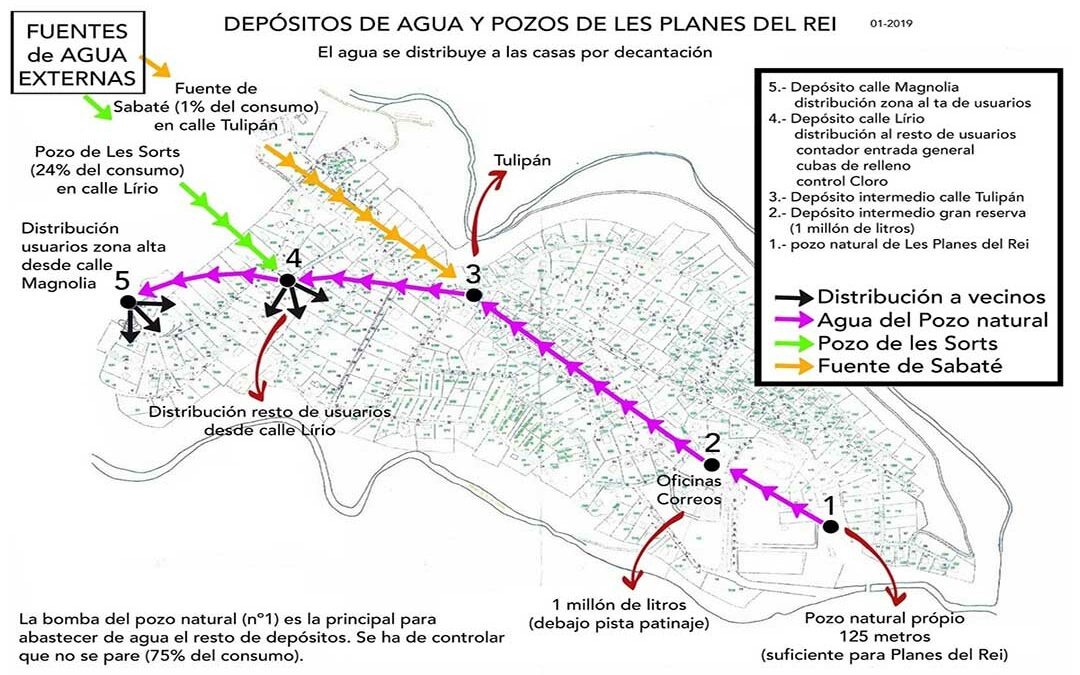
Diagram of the Les Planes del Rei water supply network produced in 2019. Two independent sources confirmed in July 2026 that its general operating principle remains valid.
The water cuts observed this July are unfortunately not a new phenomenon. For several years, residents of Les Planes del Rei have experienced supply interruptions and significant drops in pressure, mainly during the summer period.
July 2026 has been no exception.
The recent return to direct management of the water supply service by Pratdip Town Council therefore comes within an already difficult context. It would be misleading to attribute the current problems solely to this change in organisation. The events of recent weeks appear above all to reveal the limitations of an ageing network faced with particularly high summer consumption.
A single reservoir currently supplies the entire residential area
In 2019, a diagram of the water supply network was produced in order to better understand how it operates.
This week, two separate sources confirmed that this document remains valid on one essential point.
On the one hand, Mr Bruley, a long-standing property owner in Les Planes del Rei and former manager of a major wastewater treatment plant in France. On the other, a manager from the team currently responsible for supplying water to the residential area.
Both confirm that reservoir no. 4 supplies drinking water to the whole of Les Planes del Rei.
The water is then redistributed to the various sectors of the residential area, particularly to the upper reservoir supplying Magnolia and Lirio.
Why are Magnolia and Lirio the first streets to be affected ?
Located among the highest streets in the residential area, Magnolia and Lirio are supplied by reservoir no. 5.
This reservoir is itself supplied by a pump that sends water up from reservoir no. 4.
When the level in reservoir no. 4 becomes insufficient, this pump can no longer properly ensure the filling of reservoir no. 5. The latter then gradually empties as water continues to be consumed.
As Magnolia and Lirio are supplied directly by this upper reservoir, they are logically the first streets to experience a drop in pressure or even an interruption to the water supply.
The tanker trucks deployed in recent days are now temporarily reinforcing the supply to this reservoir in order to limit these situations.
Several factors combine
No single explanation can currently account for the difficulties being experienced.
Several factors instead appear to be combining :
- much higher consumption during the summer ;
- an increase in the number of people present in the residential area at the same time ;
- the limited capacity of the reservoirs ;
- a flow rate that can no longer always keep pace with consumption ;
- the operation of the pumps ;
- water losses from an ageing network.
In reality, the water cuts observed since the beginning of July appear to be the result of a combination of factors that reinforce one another rather than of a single cause.
Swimming pools are often mentioned in discussions among residents. Although they are, in principle, supposed to be filled by tanker trucks, the difficulties experienced this summer appear to result from several factors rather than from a single cause. The increase in consumption is particularly linked to the much higher occupancy of the residential area and the everyday uses that result from it.
Added to this are water losses from an ageing network. A leak, even one located several hundred metres away, reduces the volume of water available to the residential area as a whole.
A network designed for another era
The difficulties being experienced today raise a much broader question than that of water cuts alone.
The Les Planes del Rei water supply network was designed at a time when the residential area had far fewer homes and a much smaller population.
Over recent decades, new homes have been built and summer occupancy has gradually increased.
The infrastructure, however, does not appear to have developed at the same pace.
It is therefore legitimate to ask :
How has a residential area that has continued to expand over the decades been able to retain, for so long, infrastructure that now appears to be reaching its limits ?
The granting of new building permits normally requires an assessment of the capacity of the existing networks and, where necessary, provision for their adaptation.
This question inevitably leads back to the decisions taken over previous decades.
The current situation was not created in a matter of weeks. It is probably the result of the gradual development of the residential area without sufficient modernisation of its infrastructure.
The current mayor, Sílvia Carrillo, has inherited a particularly complex situation. The measures implemented in recent days — increased monitoring of the installations, work on the pumps, the use of tanker trucks and the repair of several leaks — instead demonstrate a willingness to manage a situation that has become critical with the resources currently available to the municipality.
Better anticipation of critical periods
Emergency measures help to limit the consequences of water cuts, but they also highlight the importance of continuous monitoring of the network.
Several measures already appear essential :
- regularly monitoring reservoir levels ;
- intervening before they are almost empty ;
- detecting leaks quickly ;
- maintaining an effective information system for residents ;
- deploying exceptional resources such as tanker trucks whenever necessary.
These measures can improve the day-to-day operation of the service.
In the longer term, however, they cannot replace consideration of how the infrastructure should be adapted to the residential area’s current needs.
Beyond the water cuts
The events of this July have at least had the merit of highlighting questions that go far beyond supply interruptions alone.
- What is the network’s actual capacity today ?
- Are the reservoirs still suited to the residential area’s current needs ?
- What is the true level of water loss ?
- What investment will be required over the coming years ?
- And above all, how can a reliable water supply service meeting residents’ needs be guaranteed over the long term ?
These questions do not concern the summer of 2026 alone.
They concern the very future of Les Planes del Rei.
Understanding the causes of the water cuts is a first step. Finding lasting solutions will undoubtedly be the real challenge of the coming years.
24/07/2026
La Tribune de Planas
Reference documents
For readers wishing to examine the operation of the network in greater detail, the 2019 diagram is available in a larger format.
View the water supply network diagram (2019)
Read also: The Town Council adopts a new water ordinance: what changes… and what remains unanswered