In October 1964, an explanatory report accompanied the Partial Urban Development Plan for “Las Planas del del Rey”. Registered on 24 November 1964, the document sets out the reasons behind the creation of the development, as well as the proposed organisation of its infrastructure and services.
Above all, this report provides essential information about the original division of responsibilities: the developer was expected to build and maintain the development until it was formally transferred to and accepted by Pratdip Town Council.
A residential development away from the coast
The document begins by describing the rapid expansion of coastal areas. According to its authors, population density, rising land prices and the concentration of beaches and public establishments made the coast less suitable for people seeking peace, privacy and a family environment.
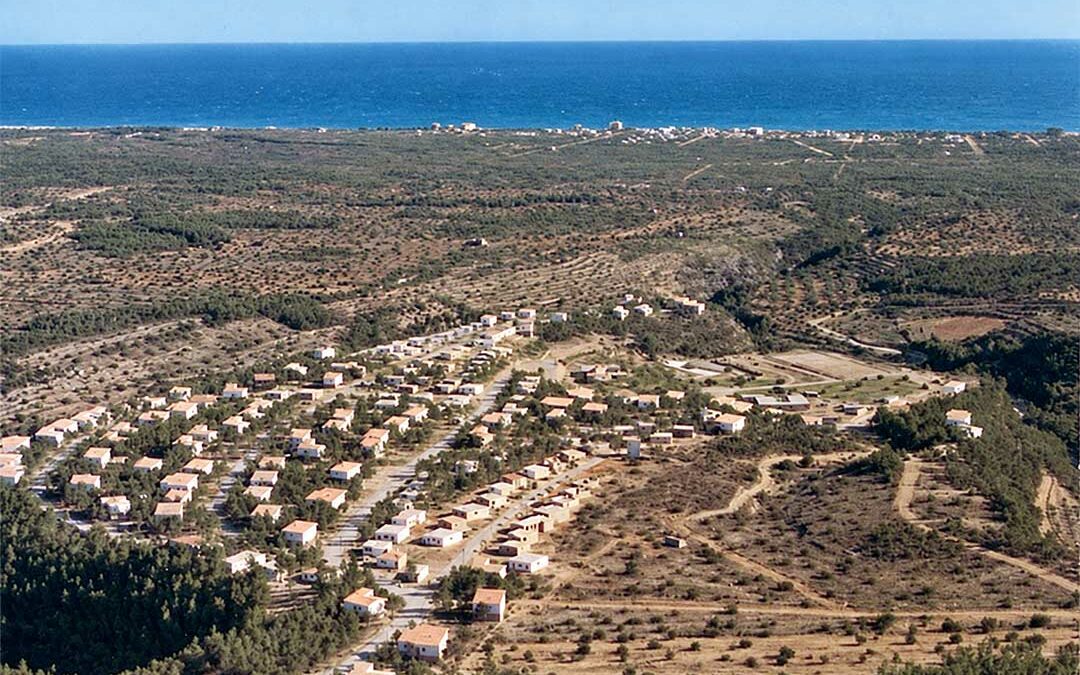
Planas del Rey was therefore presented as an inland alternative: a low-density, exclusively residential development consisting of plots that were more affordable than those located beside the sea.
The project also highlights the area’s natural advantages: a drier climate due to its altitude, proximity to the beaches, panoramic views and surrounding pine forests.
The developer was responsible for the works
The owner of the estate and developer of the project was Francis Émile Alexandre Lebasque.
The report states that all development works were to be carried out at his expense. He was also responsible for awarding the various contracts required, whether through a competitive process, direct contracting or direct management.
The document therefore did not envisage Pratdip Town Council financing the initial construction of the development. This responsibility rested with the developer.
Infrastructure and services clearly included in the plans
The report lists several facilities and services intended for the residents’ shared use:
- sewerage;
- road maintenance;
- the supply of drinking water;
- public lighting;
- waste collection;
- security.
Domestic electricity was to be managed differently. The main network would be operated by the electricity supplier, which would then establish a direct contractual relationship with each customer.
These provisions show that Planas del Rey was not conceived merely as a subdivision of privately owned plots. From the outset, the project included the infrastructure and shared services required for the development to function properly.
Temporary management by the developer
The most important part of the document concerns the maintenance of the development and the management of its services.
The report states that the owning entity was to remain responsible for them until they were transferred to and accepted by the Town Council.
During this period, plot owners were required to pay a fee to cover maintenance and upkeep costs. The developer undertook to maintain the listed public services until the development was transferred to Pratdip Town Council.
Once the development came under municipal responsibility, the Town Council would assume the same obligations in accordance with the laws and regulations governing local authorities.
At that point, owners would no longer pay the fee to the developer but would instead become liable for the taxes levied by the Town Council.
A four-year deadline for completing the project
To guarantee the project’s completion, the report states that the developer had sufficient financial resources to fund the development works, public buildings and various services.
It also indicates that the sale of plots would contribute to the project’s overall financing.
The proposed timeframe for carrying out the plan, subdividing the land and completing the construction work was four years from its approval by the higher authority. If this approval was granted in 1965, the project should therefore have been completed by around 1969.
However, this was a commitment set out in the explanatory report. The document does not, in itself, prove that the necessary financial resources were actually available or that all the announced works were subsequently completed.
A development that was never fully completed
The procedure envisaged in 1964 appears clear: the developer was to build the infrastructure, maintain the development and organise its services before transferring them to Pratdip Town Council.
However, events did not unfold as planned. Planas del Rey was never fully completed, meaning that its formal acceptance as a whole by the Town Council could not follow the procedure originally envisaged.
A paradox nevertheless emerged in the years that followed: despite the development remaining unfinished and never being formally accepted in its entirety, Pratdip Town Council continued to grant building permits, allowing new homes to be built and Planas del Rey to expand gradually.
The granting of these permits did not legally amount to the formal acceptance of the development as a whole. It does, however, show that the Town Council was aware of its expansion and authorised it, even though not all the infrastructure included in the original plans had been completed.
The entire subsequent history of Planas del Rey has been shaped by this situation: a development that remained unfinished but continued to expand for many years.
Jim – La Tribune de Planas
The original document
1964-11-24-plan-parcial-de-ordinacion-urbana-memoria-justificativa