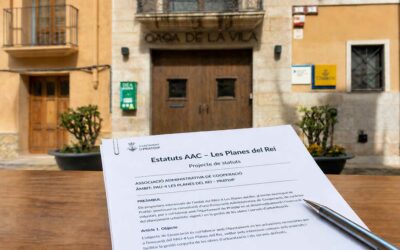

Photograph of the former headquarters of the EUCC of Planas del Rey. This urbanisation management and conservation entity was dissolved in 2016 following several legal proceedings initiated by the SOS Planas association.
Since the announcement of the AAC project, some property owners see it as a tool for participation and representation. Others fear that it could represent the return, in another form, of a system similar to the former EUCC.
Does the AAC represent a return of the former EUCC?
This is a legitimate question and one that regularly arises in discussions among property owners.
For many years, the EUCC played an important role in the management of the development, and many owners still remember the annual contributions, maintenance works, financial difficulties and numerous conflicts that marked that period.
In this context, it is understandable that the possible creation of an AAC raises questions and, at times, concerns.
The purpose of this article is not to take a position for or against an AAC, but rather to explain the main differences between these two entities.
From a legal perspective, an AAC and an EUCC are two different entities.
A brief reminder: What was the EUCC?
The EUCC (Urban Planning Conservation and Collaboration Entity) carried out various management and maintenance functions within the Planas del Rey development for many years.
Its operation was based in particular on contributions paid by property owners to finance routine infrastructure maintenance, repairs and various operating expenses.
The EUCC of Planas del Rey remained active for nearly 28 years before being dissolved in 2016 following several legal proceedings initiated by the property owners’ association SOS Planas.
For some owners, the fact that the EUCC remained in place for almost three decades without the urbanisation compliance works ever being carried out partly explains the questions currently being raised regarding the possible creation of an AAC.
What was the role of the EUCC?
The EUCC was primarily responsible for maintaining and preserving the development.
Its responsibilities included:
- routine infrastructure maintenance;
- repairs;
- workers and staff management;
- certain operating expenses;
- the day-to-day management of the development.
To finance these activities, property owners were required to pay regular contributions in addition to municipal taxes (IBI).
What is the role of an AAC?
An Administrative Cooperation Association is an urban planning entity provided for under Catalan legislation.
Its main purpose is to allow property owners to participate in the monitoring of an urban planning process and to cooperate with public authorities.
In existing examples across Catalonia, the functions of an AAC generally include:
- representing property owners;
- monitoring projects and works;
- defending the interests of its members;
- overseeing certain expenditures;
- submitting observations and proposals;
- participating in discussions with public administrations.
An AAC is therefore not designed, by its very nature, to serve as a structure responsible for the permanent maintenance of a development.
Will property owners still have to pay?
This question comes up frequently.
It is important to distinguish between two different realities.
On the one hand, there were the former contributions intended to finance the operation and routine maintenance of the EUCC.
On the other hand, there are the costs related to the reparcelación process and the future upgrading works within the development.
At this stage, everything suggests that property owners may be required to contribute to the financing of certain regularisation or infrastructure improvement works.
The possible participation of property owners in financing certain works should not be confused with the annual contributions that were once used to fund the operation and routine maintenance of the EUCC.
Why will the statutes be important?
If an AAC were eventually to be created in Planas del Rey, many of the answers would depend on the content of its statutes.
They would need to specify, among other things:
- its exact mission;
- its duration;
- its powers;
- its control mechanisms;
- the methods of representation of property owners;
- the rules governing financial transparency.
The statutes will also determine whether the AAC retains a limited role of representation and oversight or whether its powers may evolve over time. This is one of the reasons why their content is already attracting considerable attention among property owners.
These issues will probably form the core of the debate over the coming months.
Understanding before drawing conclusions
At this stage, it is probably too early to draw definitive conclusions regarding a possible AAC in Planas del Rey.
One thing already seems clear, however: an AAC and an EUCC are not the same legal structure and do not pursue the same objectives.
As with many aspects of the Planas del Rey dossier, the answers will largely depend on the specific arrangements that are proposed, the statutes that are drafted and the guarantees offered to property owners.
Before being for or against it, it is probably useful to understand exactly what it is.
12/06/2026
Jim – La Tribune de Planas
Read also: Administrative Cooperation Association (AAC): Understanding Before Taking a Position