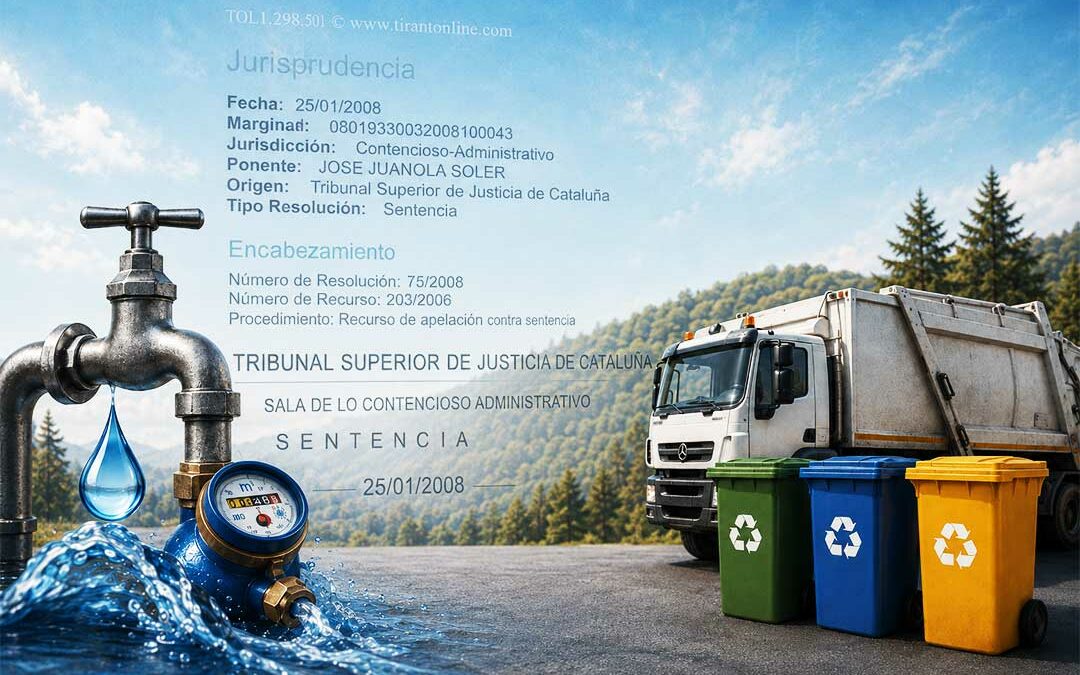
On 25 January 2008, the High Court of Justice of Catalonia (TSJC) delivered a judgment concerning several decisions taken by the Urban Development Conservation Entity of Planes del Rei (EUCC), including the way in which certain costs linked to water supply and waste collection had been included in the urban development charges claimed from property owners.
The Court partially upheld the appeal brought by one property owner.
The ruling is important, but its scope must be understood precisely: the TSJC annuls the inclusion of water-supply and waste-collection costs in the EUCC’s urban development charges. However, it does not declare in this judgment that Planas del Rey as a whole had been formally taken over by the Town Council, nor that all responsibilities for the development had passed to Pratdip.
The origin of the dispute: several EUCC decisions taken in 2004
The dispute arose from several decisions taken by the EUCC and challenged by a property owner.
The appeal concerned, among other matters, resolutions adopted by the Entity at an assembly held in 2004, as well as the rejection by administrative silence of appeals lodged with Pratdip Town Council against those resolutions.
Among the many issues raised were the Entity’s accounts, certain works, subsidies, the situation of the swimming pool, the formal takeover of the development and, particularly for the purposes of this article, the charging of water supply and waste collection through the EUCC’s fees.
The case had initially been heard by Administrative Court No. 1 of Tarragona. It was subsequently brought on appeal before the High Court of Justice of Catalonia.
The Court distinguishes urban development charges from water and waste services
One of the key points of the judgment concerns the nature of the costs being charged.
Pratdip Town Council and the EUCC argued, among other things, that the Entity could manage the water supply in accordance with the functions laid down in its statutes.
The TSJC nevertheless distinguishes this management activity from the functions that properly belong to an urban development conservation entity.
The Court considers that water supply and waste collection fall outside the scope of the urban development management carried out by a conservation entity. The amounts corresponding to those services cannot therefore be included, as such, in urban development charges.
In simple terms: the Court does not say that water or waste collection can never be charged for. It says that these services cannot be charged as though they were ordinary urban development costs of the EUCC.
The charges relating to water and waste collection are annulled
As a consequence of this reasoning, the TSJC declares the urban development charges arising from the contested EUCC resolutions to be null insofar as they include amounts corresponding to water supply and waste collection.
The judgment nevertheless adds an important qualification.
The annulment is made without prejudice to the possible validity of charges for those same services based on other public-law grounds.
The ruling therefore does not mean that residents of Planas del Rey are entitled to water or waste collection free of charge. It means that those amounts could not be claimed under the legal form used in the contested urban development charges.
In simple terms: the Court does not annul the principle of charging for water or waste collection; it annuls their inclusion in the EUCC’s urban development charges.
The judgment also addresses the role of the Town Council
The appellant also asked the Court to require the Town Council to supervise and regularise the collection of the waste charge and to exercise its responsibilities regarding supply, public health, and the management of water expenditure and consumption.
The TSJC considers that this request can only succeed within the limits of what it has just decided regarding the water and waste charges.
This passage should therefore not be interpreted as a general order requiring the Town Council immediately to take over all services in Planas del Rey.
The Court does not recognise a de facto takeover of Planas del Rey
Another particularly important aspect of the judgment concerns the formal takeover of the development.
The property owner asked the Court to declare that Pratdip Town Council had de facto taken over the whole development and should therefore assume responsibility for its management.
The TSJC does not uphold this request.
The Court notes that no decision concerning the formal takeover of the development works had been adopted at the 2004 assembly that gave rise to the appeal.
There was therefore no prior administrative act that could have been challenged in order for the Court to rule on that issue.
For the same reason, the Court also rejects the request to hold the Town Council liable for omission or negligence in relation to the formal takeover of the development works.
In simple terms: the TSJC does not recognise a de facto takeover of Planas del Rey in this judgment. It explains that this issue cannot be decided in these proceedings because no prior administrative decision on the takeover had been challenged.
The judgment does not resolve every issue relating to water
The appellant also raised several questions concerning ownership of the water, who was selling and billing it, and the exact responsibilities of the Town Council.
The TSJC considers, however, that these matters had not been the subject of the resolutions adopted at the contested assembly and therefore fell outside the specific scope of the appeal.
The judgment does not therefore amount to a general ruling on the entire legal framework governing water supply in Planas del Rey.
An important judgment, but with a clearly defined scope
The judgment of 25 January 2008 represents an important stage in the administrative history of Planas del Rey.
It establishes that the costs linked to water supply and waste collection do not, by their nature, form part of the urban development charges proper to a conservation entity. Their inclusion in the contested urban development charges is therefore annulled.
At the same time, the judgment also clearly sets the limits of its ruling: the Court does not recognise the administrative takeover of Planas del Rey, does not resolve every issue concerning water management, and does not transfer all responsibilities of the EUCC to the Town Council by means of this judgment alone.
This distinction is essential for understanding the agreements and decisions adopted in the years that followed.
Jim – La Tribune de Planas
Summary of the key passages of the judgment
On water supply and waste collection
The Court considers that the management of water supply and waste collection cannot be treated as equivalent to the urban development management normally carried out by an urban development conservation entity. These services fall outside the scope of urban development charges.
On the annulment of the charges
As a result, the TSJC declares null, for the purposes of these proceedings, the urban development charges arising from the EUCC resolutions of 6 October 2004 insofar as they relate to water supply and waste collection.
The judgment nevertheless states that this annulment does not prevent the existence of valid charges for those services based on other public-law grounds.
Within those limits, the Court considers that the request for the Town Council to supervise and regularise the collection of the waste charge, and to exercise the responsibilities falling to it in relation to supply, public health and the management of water expenditure and consumption, may partially succeed.
On the formal takeover of the development
The appellant asked the Court to declare that the Town Council had de facto taken over the entire development and should therefore assume responsibility for it.
The Court rejects this request because no resolution concerning the formal takeover of the development works had been adopted at the 2004 assembly and there was therefore no prior administrative act that could be challenged in these proceedings.
For the same reason, it also rejects the request to hold the Town Council liable for omission or negligence in relation to that takeover.
Operative part
The TSJC partially upholds the appeal and overturns the earlier judgment of Administrative Court No. 1 of Tarragona.
It also partially upholds the administrative appeal solely in order to declare null the urban development charges arising from the EUCC resolutions of 6 October 2004 insofar as they relate to water supply and waste collection, without prejudice to their possible validity under other public-law grounds.
All other claims are dismissed.
The judgment is final and is not subject to an appeal in cassation.